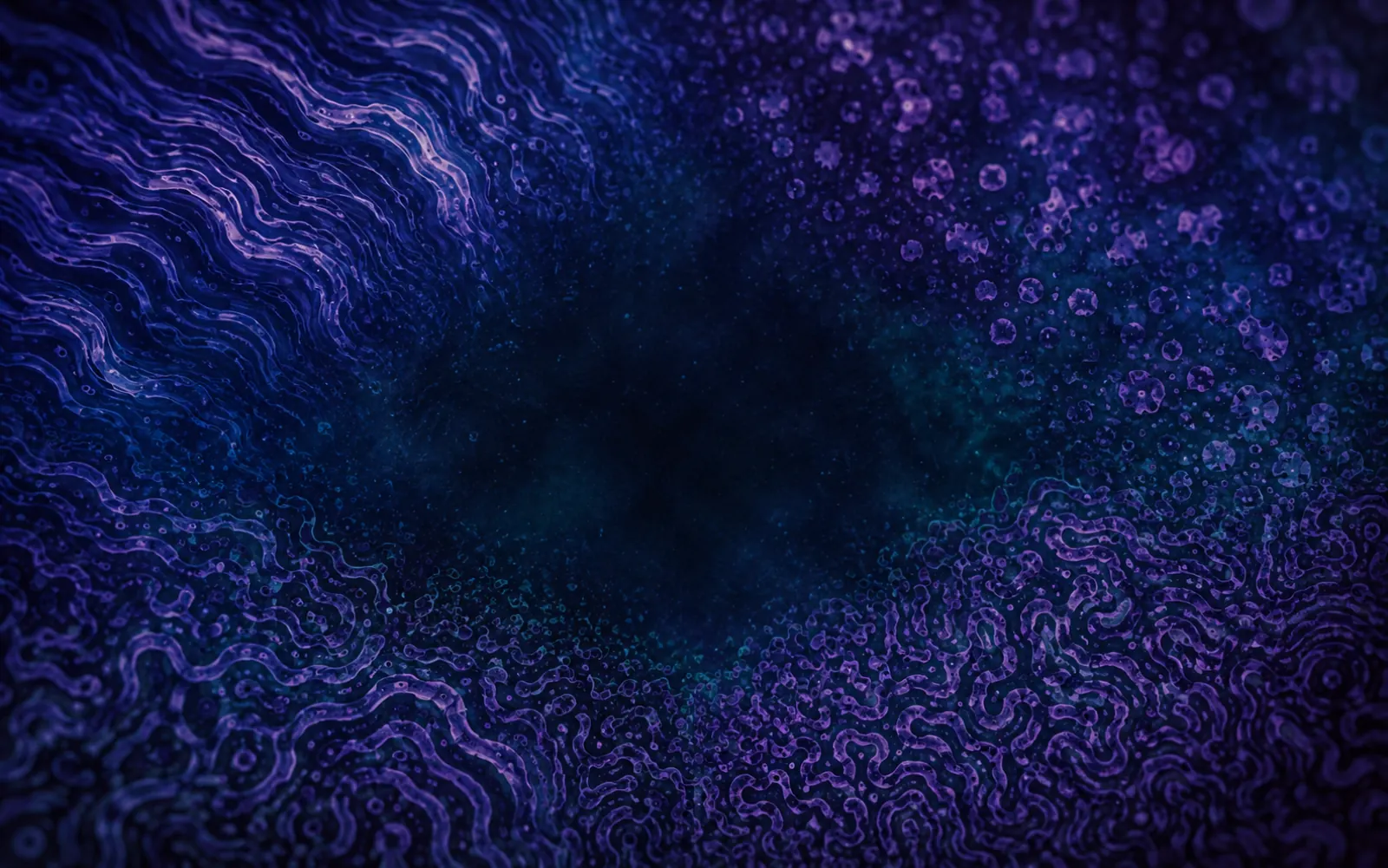
Gleiche Mathematik. Andere Spezies.
Zwei diffundierende Stoffe, ein Aktivator, ein Inhibitor, erzeugen jede Art von Muster, die wir von Tierfellen kennen. Drehe an zwei Zahlen, und derselbe Algorithmus zeichnet einen Geparden, einen Tiger, ein Zebra, eine Giraffe. Turing hat das 1952 aufgeschrieben; die Biologie holt seither auf.
Zwei Zeilen machen das alles.
Der Gray-Scott-Spezialfall des Turing-Systems. Jeder Pixel aktualisiert sich aus seinen acht Nachbarn über einen 9-Tap-Laplacian, acht bis zehnmal pro sichtbarem Frame.
Vier Momente in siebzig Jahren.
1952 — Turing schreibt es auf.
Alan Turing publiziert «The Chemical Basis of Morphogenesis» in den Philosophical Transactions B. Er postuliert, dass biologische Muster aus Stoffen entstehen, die wechselwirken und unterschiedlich schnell diffundieren. Die Mathematik stimmt; die Biologie hat damals keine Molekül-Kandidaten.
1993 — Pearson kartiert das Territorium.
John Pearson erforscht numerisch den Gray-Scott-Parameterraum und findet vierzehn verschiedene Pattern-Regionen, beschriftet α bis ρ. Die Karten in seinem Science-Paper werden zum Referenzwerk für alle, die danach kommen.
1995 — Kondo findet Turing im Fisch.
Shigeru Kondo und Rihito Asai fotografieren denselben Kaiserfisch über Monate. Seine Streifen wandern und teilen sich exakt so, wie ein Reaktions-Diffusions-Modell vorhersagt. Der erste handfeste Beweis, dass echte Tiermuster der Turing-Dynamik in vivo folgen.
2017 — Eidechsenhaut als zellulärer Automat.
Liana Manukyan und das Milinkovitch-Labor zeigen, dass die Schuppen der Perl-Eidechse ihre Farben nach einem diskreten zellulären Automaten umschalten, der selbst eine Diskretisierung der Turing-Differenzialgleichung ist. Die Brücke zwischen Turings kontinuierlicher Mathematik und diskreter Biologie wird explizit.
- Turing, A. M. (1952) — The Chemical Basis of Morphogenesis. Phil. Trans. R. Soc. B 237 (641): 37-72.
- Pearson, J. E. (1993) — Complex Patterns in a Simple System. Science 261 (5118): 189-192.
- Kondo, S. & Asai, R. (1995) — A reaction-diffusion wave on the skin of the marine angelfish. Nature 376: 765-768.
- Manukyan, L. et al. (2017) — A living mesoscopic cellular automaton in lizard skin. Nature 544: 173-179.