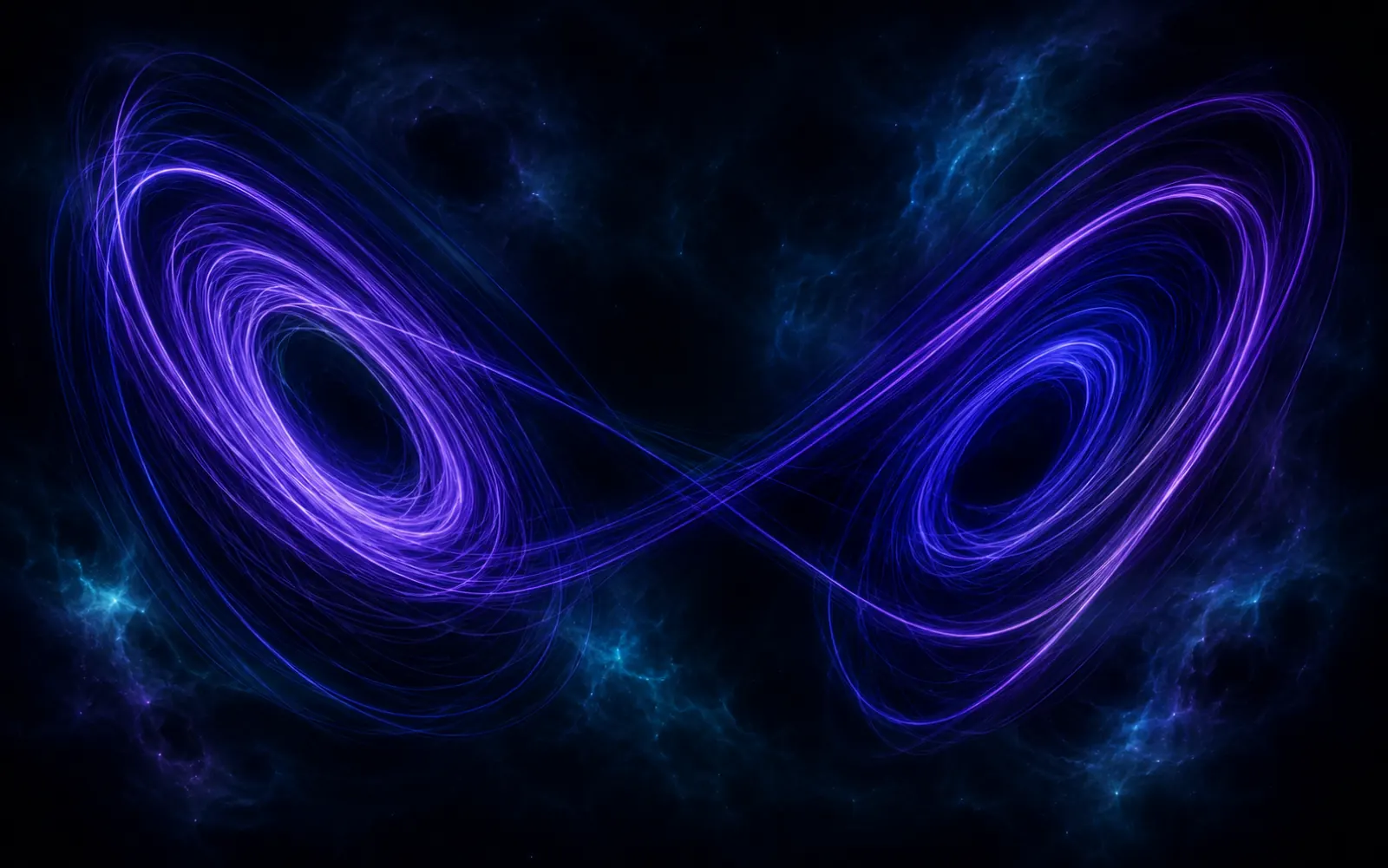
Drei Zahlen, ein Schmetterling.
Edward Lorenz schrieb 1963 drei Differentialgleichungen als Spielzeug-Modell von Konvektion auf. Er liess die Integration über Nacht auf einer Royal McBee LGP-30 laufen. Als er von einem Ausdruck aus neu startete, blies ein winziger Rundungsfehler in der sechsten Dezimale ein komplett anderes Wetter auf. Determinismus ohne Vorhersagbarkeit. Was du gerade siehst, ist die Form, die diese drei Gleichungen in den Phasenraum schnitzen.
RK1-Integration · σ ρ β als Slider · zwei Trails 0.0001 auseinander zeigen die Divergenz · prefers-reduced-motion respektiert
Drei Schieber, ein Attraktor
Die klassische Einstellung ist sigma 10, rho 28, beta 8/3. Schieb rho auf 14 und die Bahn fällt auf einen Fixpunkt. Push rho über 99 und das Chaos weicht einer stabilen Periode-3-Bahn. Die Grenzen zwischen den Regimes sind nicht glatt: Chaos kommt und geht in schmalen Fenstern.
Warum die Form zählt
Der Lorenz-Attraktor war das erste konkrete Beispiel eines seltsamen Attraktors in drei Dimensionen. Seine Existenz als rigoroses mathematisches Objekt wurde erst 1999 von Warwick Tucker mit einem computergestützten Beweis gesichert. Die ausgemeisselte Form hat Hausdorff-Dimension um 2.06: mehr als eine Fläche, weniger als ein Volumen.
1963 in Cambridge
Lorenz liess ein vereinfachtes Wettermodell auf einer Royal McBee LGP-30 laufen, langsam selbst nach 1963er Massstab. Er stoppte einen Lauf, schrieb den Zustand auf sechs Dezimalen ab und startete von diesen Zahlen neu. Der neue Lauf wich nach Stunden simulierter Zeit komplett vom Original ab. Die Verkürzung von zwölf auf sechs Dezimalen war keine Annäherung gewesen, sondern ein kleiner Stoss, den das System exponentiell verstärkte. Das Paper im Journal of the Atmospheric Sciences jenes Jahres ist die Saat moderner Chaostheorie.
Der Schmetterling-Effekt
1972 hielt Lorenz einen Vortrag vor der American Association for the Advancement of Science mit dem Titel "Setzt der Flügelschlag eines Schmetterlings in Brasilien einen Tornado in Texas in Gang?". Der Titel kam von einem Kollegen, der Lorenz vor dem Druck des Programms nicht erreichte. Das Bild blieb. Was es eigentlich sagt: empfindliche Abhängigkeit von Anfangsbedingungen. Zwei Zustände, die für jede endliche Messung gleich aussehen, trennen sich mit exponentieller Rate.
Seltsam und beschränkt
Jede Bahn in diesem Zustandsraum, egal wo sie startet, wird auf dasselbe schmetterlingsförmige Objekt gezogen. Das ist der Attraktor-Teil. Der seltsame Teil: das Objekt hat fraktale Struktur. Schau es genauer an, und die Flügel zeigen Schichten von Flügeln. Die Hausdorff-Dimension wurde 1983 von Grassberger und Procaccia numerisch zu 2.062 geschätzt.
Warum Wettervorhersagen eine Grenze haben
Echte Atmosphären sind unendlichdimensionale Lorenz-Systeme, empfindlich für winzige Störungen in Temperatur, Feuchte und Wind. Die Verdoppelungszeit kleiner Fehler liegt bei zwei bis drei Tagen. Numerische Wettervorhersage kann die nützliche Reichweite mit besseren Messungen und grösseren Ensembles ausdehnen, aber nicht über zwei bis drei Wochen hinaus. Das Chaos sitzt in den Gleichungen, nicht im Computer.
Quellen
- Lorenz E.N. (1963). Deterministic Nonperiodic Flow. Journal of the Atmospheric Sciences 20, 130–141.
- Lorenz E.N. (1972). Predictability: Does the Flap of a Butterfly's Wings in Brazil Set Off a Tornado in Texas? AAAS Address, 139th Meeting.
- Tucker W. (1999). The Lorenz attractor exists. Comptes Rendus de l'Académie des Sciences, Série I 328, 1197–1202.
- Strogatz S.H. (1994). Nonlinear Dynamics and Chaos. Chapter 9 covers the Lorenz system as the canonical low-dimensional chaos.