Sechs Experimente, an denen die klassische Anschauung scheitert.
Von Youngs Schlitzen 1804 bis zur Verzögerten Wahl Wheelers: der Doppelspalt ist das eine Experiment, das sich nicht einordnen lässt. Sechs Sektionen, jede interaktiv. Keine Mystik: die Auflösung ist Feynmans Pfadintegral.
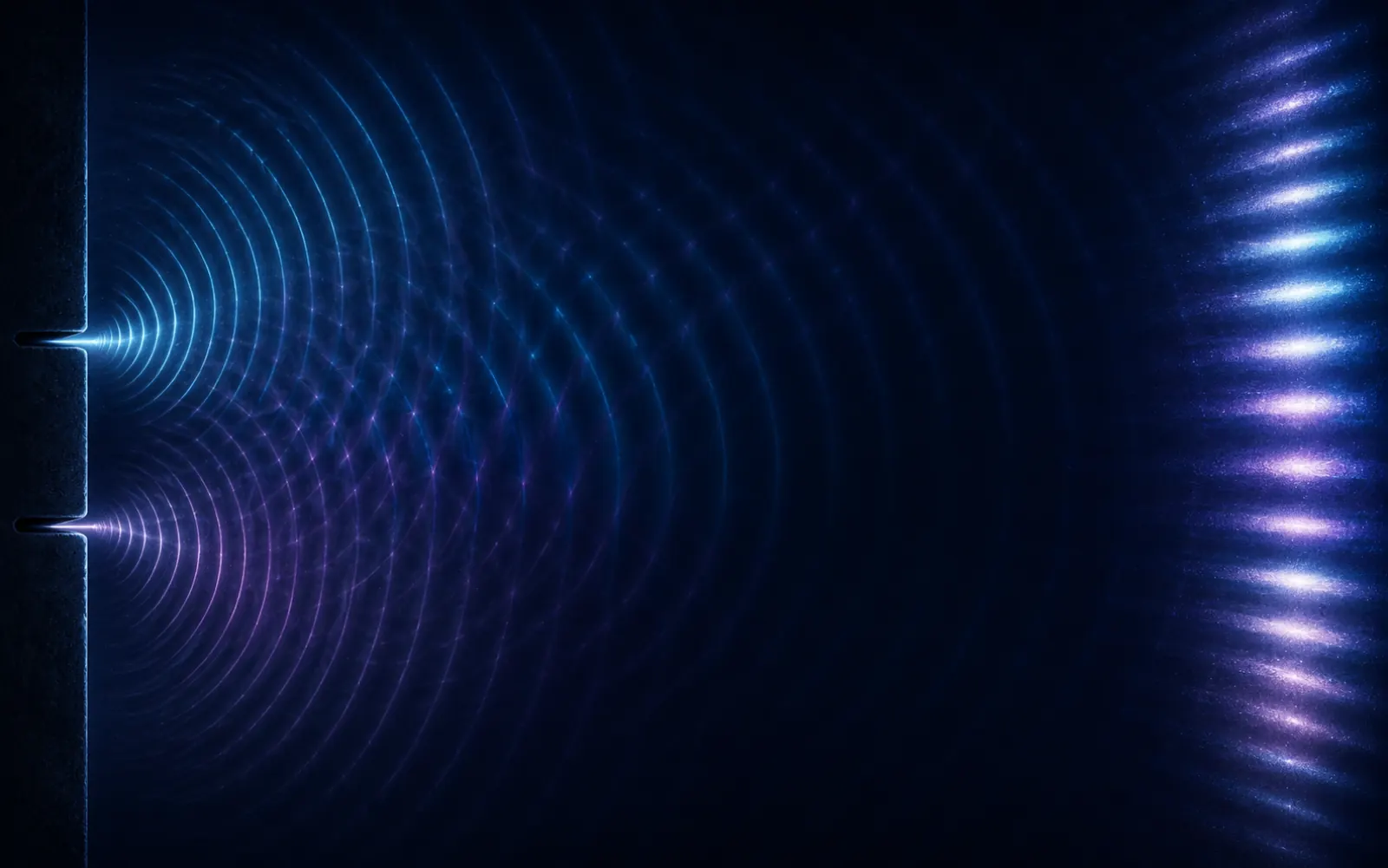
Licht ist eine Welle.
Zwei kohärente Quellen erzeugen helle und dunkle Streifen genau dort, wo Wellenberge sich addieren oder auslöschen. Wellenlänge, Schlitzabstand und Schirmabstand sind variabel. Der Streifenabstand folgt x = λL/d.
Ein Teilchen ist genug.
Selbst wenn nur ein einziges Quantum gleichzeitig im Apparat ist, baut sich das Streifenmuster Punkt für Punkt auf. Das Muster ist also kein kollektives Wellen-Phänomen: es existiert pro Teilchen. Wähle eine Masse: vom einzelnen Photon bis zum 25-kDa-Oligoporphyrin (Fein-Geyer-Arndt 2019, immer noch 90 % Sichtbarkeit).
Hinsehen zerstört das Muster.
Sobald der Apparat im Prinzip verraten könnte, durch welchen Spalt das Teilchen ging, verschwimmen die Streifen zur klassischen Summe. Englert hat das in die Ungleichung V² + K² ≤ 1 gegossen: volle Welcher-Weg-Information K = 1 erzwingt Sichtbarkeit V = 0, und umgekehrt. Kein Bewusstsein nötig: ein Stück Papier hinter einem Spalt reicht.
Alle Wege tragen bei.
Feynmans Pfadintegral: das Teilchen wählt keinen Spalt. Jede denkbare Trajektorie trägt eine Amplitude e^(iS/ℏ), die Summe ergibt die Wahrscheinlichkeit. Klassische Bahnen tauchen als stationäre-Phasen-Anhäufung auf. Verschieb das Ziel auf dem Schirm und sieh wie der Phasor-Spiral-Sum sich live in Konstruktion oder Destruktion biegt.
Wissen löschen: die Streifen kommen zurück.
Ein verschränktes Photonen-Paar, geboren in einer SPDC-Quelle. Das Signal-Photon geht durch die Schlitze mit Viertelwellen-Platten, die seine Polarisation pro Spalt markieren. Die Streifen sind weg. Misst man den Partner (Idler) in der komplementären Basis, löscht man die Welcher-Weg-Information: Streifen erscheinen wieder in Koinzidenz. Wichtig: Die Marginal-Verteilung des Signals ändert sich nie. Information fliesst nicht rückwärts.
Entscheidung erst nachdem das Photon eingetreten ist.
Wheelers Gedankenexperiment: erst nachdem ein Photon den ersten Strahlteiler passiert hat, entscheiden, ob der zweite eingefügt wird (Interferometer → Wellen-Verhalten) oder offen bleibt (Welcher-Weg → Teilchen-Verhalten). Jacques et al. 2007 realisierten das mit einem 48-m-Mach-Zehnder, einem Elektro-Optischen Modulator unter 40 ns Schaltzeit und raumartiger Trennung. Das Photon zeigt das jeweils passende Verhalten.
Sektion 1 rendert das 2D-Wellenfeld mit 1/√r-Dämpfung, eine zylindrische Wellen-Idealisierung; die echte Frei-Raum-Welle fällt mit 1/r. Sektion 2 sampelt aus P(y) ∝ cos²(πdy/(λL)) mit Gauss-Hülle. Die Bildschirm-Wellenlängen sind visuelle Skalierungen; die de-Broglie-Anzeige zeigt die echten Werte (Elektron 50 keV → 5.4 pm relativistisch, C₆₀ aus Arndt-Zeilinger 1999 bei ~220 m/s, 25-kDa-Oligoporphyrin aus Fein-Geyer-Arndt 2019 bei 175 m/s). Sektion 4 nutzt die optische Action-Approximation S = p·L; der ℏ-Slider ist ein Visualisierungs-Parameter, nicht die echte Konstante. Sektion 5 plottet die saubere Walborn-Theorie V = |cos 2θ|, nicht gesampelte Daten. Sektion 6 vereinfacht BS2-in zu IMMER D₁ (Phasendifferenz 0); ein realer Mach-Zehnder zeigt ein Interferenz-Muster als Funktion der Armlängen-Differenz.
- Young, T. (1804) — The Bakerian Lecture: Experiments and Calculations Relative to Physical Optics. Phil. Trans. R. Soc. 94.
- Davisson, C. & Germer, L. H. (1927) — The Diffraction of Electrons by a Crystal of Nickel. Phys. Rev. 30.
- Tonomura, A. et al. (1989) — Demonstration of single-electron buildup of an interference pattern. Am. J. Phys. 57.
- Arndt, M. et al. (1999) — Wave-particle duality of C60 molecules. Nature 401.
- Bach, R. et al. (2013) — Controlled double-slit electron diffraction. New J. Phys. 15.
- Fein, Y. Y. et al. (2019) — Quantum superposition of molecules beyond 25 kDa. Nat. Phys. 15.
- Feynman, R. P. (1948) — Space-Time Approach to Non-Relativistic Quantum Mechanics. Rev. Mod. Phys. 20.
- Englert, B.-G. (1996) — Fringe Visibility and Which-Way Information: An Inequality. Phys. Rev. Lett. 77.
- Dürr, S., Nonn, T. & Rempe, G. (1998) — Origin of quantum-mechanical complementarity probed by a 'which-way' experiment in an atom interferometer. Nature 395.
- Scully, M. O. & Drühl, K. (1982) — Quantum eraser: A proposed photon correlation experiment concerning observation and 'delayed choice' in quantum mechanics. Phys. Rev. A 25.
- Walborn, S. P. et al. (2002) — Double-slit quantum eraser. Phys. Rev. A 65, 033818.
- Kim, Y.-H. et al. (2000) — A Delayed Choice Quantum Eraser. Phys. Rev. Lett. 84.
- Jacques, V. et al. (2007) — Experimental Realization of Wheeler's Delayed-Choice Gedanken Experiment. Science 315.
- Manning, A. G. et al. (2015) — Wheeler's delayed-choice gedanken experiment with a single atom. Nat. Phys. 11.