Die Atmosphäre ist eine grosse Maschine.
Die Sonne trifft den Äquator härter als die Pole. Die Atmosphäre verbringt jede Sekunde damit, diese Wärme umzuverteilen, und die Erdrotation biegt jede Bewegung in eine Kurve. Das Resultat sind drei Zirkulations-Zellen pro Halbkugel, die Passatwinde, die Westwinde und zwei schnelle Luftbänder namens Jet-Streams. Wechsle zwischen der Oberfläche, die du atmest, und dem Jet-Stream, der dein Wetter lenkt.
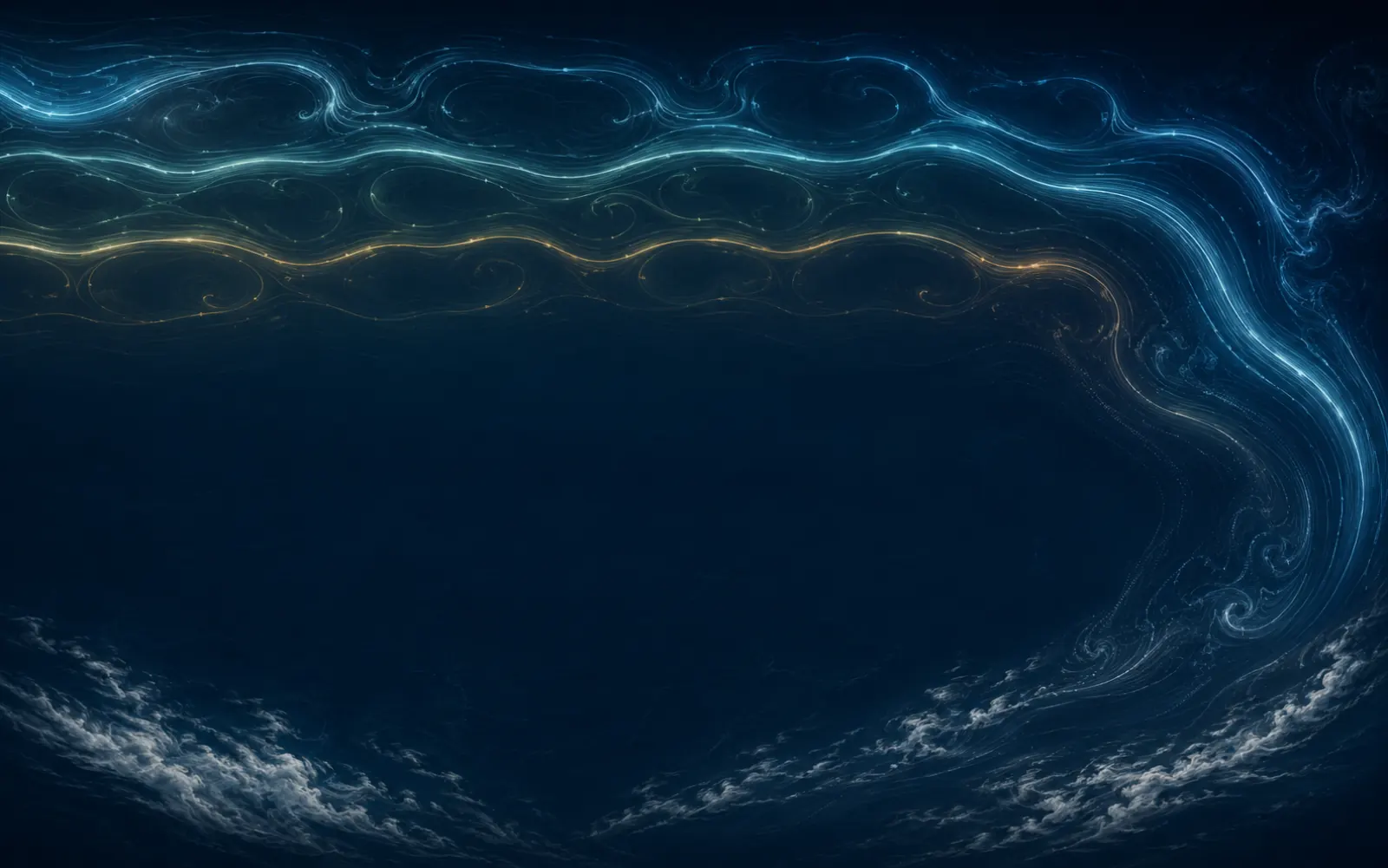
Das Geschwindigkeits-Feld ist rekonstruiert aus klimatologischen Positionen und Stärken der Passatwinde, Westwinde, polaren Ostwinde, der ITCZ, beider Jet-Streams und acht permanenter Drucksysteme (Holton 2004, NOAA GFS, Copernicus ERA5 Klimatologie). Der Jet-Mäander folgt einer einfachen Rossby-Wellen-Parametrisierung. Es ist keine Live-Vorhersage. Das Ziel ist ein treues, lesbares Bild des Jahresmittels. Die Küstenlinien sind Natural-Earth-110m-Outlines, ohne Füllung gezeichnet weil der Wind Kontinente frei überquert. Die Partikel-Farbe zeigt die Lufttemperatur: jeder Partikel trägt einen eigenen °C-Wert, Boden-Werte basieren auf der Breite mit Land-Kälte-Bias, Jet-Werte sind durchgehend kalt (~−50 °C). Schnelle Partikel mischen langsamer. Darum bleibt der Polar-Jet auf seiner ganzen Runde eisblau.
Drei Zellen, zwei Jets, acht Drucksysteme.
Die drei Zellen.
Am Äquator steigt warme Luft auf. Bei dreissig Grad Nord und Süd sinkt sie wieder ab, und die absteigende trockene Luft schnitzt die subtropischen Wüsten in den Globus. Die Zelle zwischen Äquator und 30° trägt seit 1735 den Namen George Hadleys. Die Zelle von 30° bis 60° heisst Ferrel-Zelle, von 60° bis zum Pol Polar-Zelle. Jede schliesst ihre eigene Schleife, und die Erdrotation kippt jeden Wind in jeder Zelle in die Kurven die du siehst: Passatwinde wehen in den Tropen von Osten, Westwinde dominieren die mittleren Breiten, polare Ostwinde sitzen oben drauf.
Jet-Streams und Rossby-Wellen.
An der Grenze zwischen den Zellen, wo kalte Polarluft auf warme Subtropenluft trifft, beschleunigt der Temperaturkontrast ein schmales Luftband auf etwa zehn Kilometer Höhe: den Polar-Jetstream. Er erreicht 400 km/h. Er läuft nicht gerade. Er mäandert in langen Rossby-Wellen um den Planeten, und diese Mäander steuern die Stürme darunter. Francis & Vavrus (2012) zeigten: die Arktische Amplifikation, die überproportionale Erwärmung der Arktis, macht den Jet welliger, langsamer, anfälliger fürs Steckenbleiben. Ein steckender Jet bedeutet steckendes Wetter: Hitzewellen die nicht enden, Fluten die nicht weiterziehen.
Wo Wetter geboren wird.
Absinkende Luft bei 30° erzeugt permanente Hochdruckgebiete: das Azoren-Hoch über dem Nordatlantik, das Pacific-Hoch vor Kalifornien, das St-Helena-Hoch im Südatlantik. Aufsteigende Luft über warmen Ozeanen und Land-Wasser-Kontrasten erzeugt persistente Tiefs: das Island-Tief, das Aleuten-Tief. Jedes ist ein Wirbel, den du in der Visualisierung sehen kannst: im Norden Hochs im Uhrzeigersinn, Tiefs gegen den Uhrzeigersinn; im Süden umgekehrt weil Coriolis dort spiegelt. Das Azoren-Hoch entscheidet, ob Westeuropa einen trockenen Sommer kriegt; das Aleuten-Tief, ob der Pazifische Nordwesten erneut absäuft.
Was der Wind transportiert.
Saharastaub überquert den Atlantik und düngt den Amazonas-Regenwald mit Phosphor (van der Does et al. 2020). Pollen, Pilzsporen und Bakterien reisen auf transozeanischen Strömungen. Globale Ökologie ist teilweise ein Luft-Netzwerk. Methan aus tauendem Permafrost mischt sich innerhalb von Monaten über die ganze Hemisphäre. Mikroplastikfasern zirkulieren mittlerweile in stratosphärischen Luftproben. Dieselben Winde, die Wärme verschieben, verschieben was wir in die Luft entlassen, und die Reise ist schnell: ein Saharasturm erreicht Florida in fünf Tagen.
- Holton, J. R. (2004) — An Introduction to Dynamic Meteorology (4th ed.). Academic Press.
- NOAA GFS — Global Forecast System (operational numerical weather prediction).
- Copernicus Climate Data Store — ERA5 global reanalysis.
- Francis, J. A. & Vavrus, S. J. (2012) — Evidence linking Arctic amplification to extreme weather in mid-latitudes. Geophys. Res. Lett. 39.
- van der Does, M. et al. (2020) — The mysterious long-range transport of giant mineral dust particles. Science Advances 4.
- IPCC AR6 WG1 — Chapter 8: Water Cycle Changes.
- Hadley, G. (1735) — Concerning the cause of the general trade-winds. Phil. Trans. R. Soc. 39.