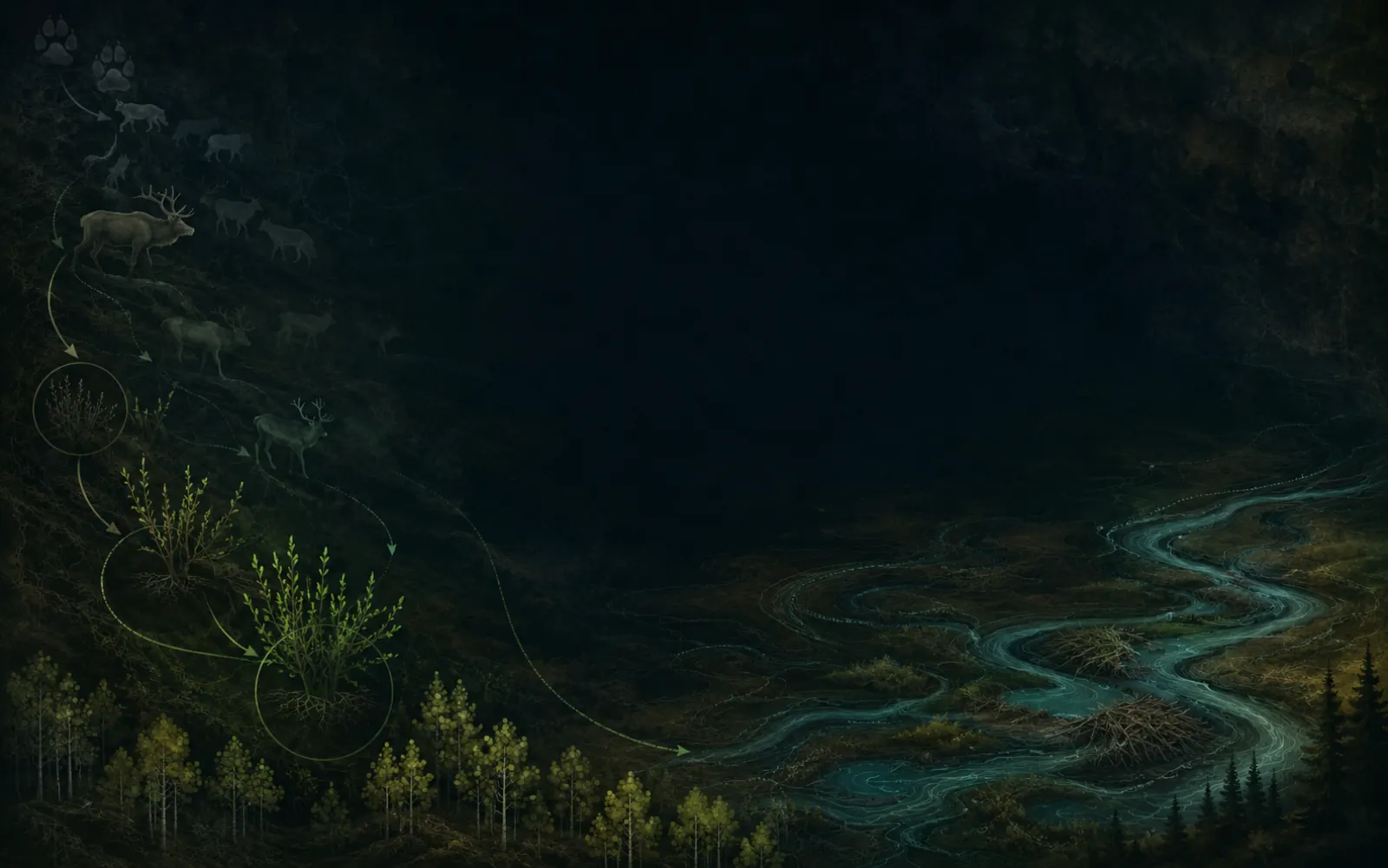
Wölfe wieder ansiedeln, ein Fluss mäandriert anders.
Fünf Sektionen vom kaputten Tal 1994 über die Wieder-Ansiedlung 1995, den kaskadierenden Graphen vom Wolf bis zum Flussbett, das Metrik-Dashboard nach 30 Jahren bis zur ehrlichen wissenschaftlichen Kontroverse, ob die Geschichte wirklich so sauber ist.
1994. Neunzehntausend Elche und kein Top-Räuber.
Wölfe waren seit 1926 verschwunden, ausgerottet im US-Bundes-Räuber-Kontrollprogramm. Anfang der 1990er trug die Northern Range rund 19 000 Elche, Weiden entlang des Lamar waren zu Stumpen abgefressen, Espen-Sämlinge erreichten kaum die Verbisshöhe, Biber waren zu einer einzigen Kolonie am Yellowstone River kollabiert. Flussufer erodierten. Das Tal sah müde aus.
Einunddreissig Wölfe zwischen 1995 und 1996.
Vierzehn Wölfe aus Alberta 1995, siebzehn aus British Columbia 1996, ausgelassen über sanfte Akklimatisierungs-Pferche im Lamar-Tal. Der Bestand spitzte 2003 über 170, sank durch Staupe und Räude, stabilisiert sich seit 2015 bei rund 100. Heute rund 108 Wölfe in 8 Rudeln.
Fünf Schichten bis zum Flussbett.
Die Lehrbuch-Trophische-Kaskade als gerichteter azyklischer Graph. Wölfe senken Elch-Zahlen und ändern Elch-Verhalten (sie meiden offene Täler). Weide, Espe, Pappel erholen sich. Biber kehren zurück, wo Weiden wieder wachsen. Biber-Dämme ändern die Flussmorphologie. Singvögel und Forelle folgen. Spiel die Welle ab, sieh sie kaskadieren.
Orange = positiver Effekt. Blau = negativ oder verhaltensändernd. Partikel reisen entlang der tatsächlichen Wirkrichtung.
Was sich tatsächlich verändert hat.
Vier Metriken mit Vorher-Nachher-Werten aus den zitierten Monitoring-Programmen. Elche auf rund ein Drittel des 1994er-Höchststands. Biberkolonien zwölfmal höher. Espen-Sämlinge endlich über Verbisshöhe. Weidenbedeckung fast verdreifacht. Jede Karte zitiert ihre Datenquelle.
Die sauberste Kaskaden-Story hat auch Kritiker.
Yellowstone wurde zum Lehrbuch-Beispiel der trophischen Kaskade und landete auf TED-Bühnen, in Naturdokumentationen, in viralen Videos mit Millionen Klicks. Andere Ökologen widersprachen: die einfache Story lässt das Klima-Signal aus, den Elch-Population-Teil der Kette, und ein Sampling-Bias-Problem bei den Weiden-Daten. Beiden Seiten geht es darum, das richtig hinzukriegen.
- Wölfe änderten, wo Elche fressen: offene Täler und Flussufer bekamen weniger Verbissdruck, direkt mit GPS-Halsbändern und Wildkameras nachgewiesen.
- Weidenhöhen, Espen-Verjüngung, Biberkolonien und Singvogel-Counts reagierten messbar ab etwa 2000. Langzeit-Monitoring über mehrere Wassereinzugsgebiete zeigt dieselbe Richtung.
- Unabhängige Labore replizierten die Kernbefunde; die direktionale Aussage, dass Wölfe die Riparial-Erholung modifizieren, überlebt die meisten Kritiken.
- Der Elch-Rückgang begann mit der Jagd ausserhalb des Parks und mit Trockenheit, bevor die Wolfspopulation gross genug war, um zu zählen. Klima und Jagd trieben wahrscheinlich den Grossteil des Elch-Drops.
- Espen-Erholung passierte nur in manchen Beständen, nicht parkweit; mit vollständiger Abdeckung analysiert schwächt sich das Signal.
- Brice 2022 zeigte: Weiden-Studien hatten systematischen Sampling-Bias hin zu leicht messbaren, sich erholenden Beständen. Bei Korrektur schrumpft der scheinbare Erholungseffekt deutlich.
Wölfe sind zurück. Elch-Zahlen sind gefallen. Riparial-Vegetation hat sich erholt. Die Kaskade als Richtungs-Story hält. Ob Wölfe die dominante Ursache oder eine von mehreren sind, ist ehrlich nicht geklärt, und die Magnituden in viralen Videos sind wahrscheinlich übertrieben. Die ehrliche Position: Kaskade real, Magnituden umstritten.
Wolf-Populationsdaten 1994-2024 stammen aus den NPS Yellowstone Wolf Project Annual Reports. Elch-Zahlen sind Northern-Range Late-Winter-Counts (NPS). Biberkolonien-Counts folgen Smith et al. 2022 am Yellowstone River. Espen-Verjüngungshöhen aus Painter et al. 2018; Weidenbedeckung aus Beschta & Ripple 2016. Der Kaskaden-Graph in Sektion 3 ist ein gerichteter azyklischer Graph, keine Simulation: Kanten-Gewichte sind visuell nicht quantitativ, die Propagations-Animation ist rein pädagogisch um Richtung zu zeigen. Sektion 1 ist eine stilisierte Illustration, keine photographischen Daten.
- Ripple, W. J. & Beschta, R. L. (2003) — Wolf reintroduction, predation risk, and cottonwood recovery in Yellowstone National Park. Forest Ecology and Management 184, 299-313.
- Ripple, W. J. & Beschta, R. L. (2012) — Trophic cascades in Yellowstone: The first 15 years after wolf reintroduction. Biological Conservation 145, 205-213.
- Kauffman, M. J., Brodie, J. F. & Jules, E. S. (2010) — Are wolves saving Yellowstone's aspen? A landscape-level test of a behaviorally mediated trophic cascade. Ecology 91, 2742-2755.
- Middleton, A. D. et al. (2013) — Linking wolves and plants: Aldo Leopold on trophic cascades. BioScience 63, 78-86.
- Marris, E. (2014) — Rethinking predators: legend of the wolf. Nature 507, 158-160.
- Beschta, R. L. & Ripple, W. J. (2016) — Riparian vegetation recovery in Yellowstone: the first two decades after wolf reintroduction. Biological Conservation 198, 93-103.
- Painter, L. E., Beschta, R. L., Larsen, E. J. & Ripple, W. J. (2018) — Recovering aspen follow changing elk dynamics in Yellowstone: evidence of a trophic cascade? Ecology 99, 2237-2249.
- Smith, D. W. et al. (2020) — Yellowstone National Park Wolf Project Annual Report 1995-2020. NPS Yellowstone Center for Resources.
- Eisenberg, C., Hibbs, D. E. & Ripple, W. J. (2014) — Effects of predation risk on elk (Cervus elaphus) landscape use in a wolf (Canis lupus) dominated system. Canadian Journal of Zoology 92, 1-9.
- Brice, E. M., Larsen, E. J. & MacNulty, D. R. (2022) — Sampling bias exaggerates a textbook example of a trophic cascade. Ecology Letters 25, 177-188.